How Winter Attractions Move From Concept to Site Plan

Turning a seasonal idea into a working attraction starts well before anyone breaks ground. Operators typically spend six to twelve months in pre-development before a single structure is installed, working through feasibility questions that go far beyond whether the idea sounds appealing.
Location is where most projects succeed or fail early. A site needs enough flat, accessible land to support multiple zones – skating, food, lighting trails, entertainment – without cramming them together. Proximity to public transport matters more than many operators initially expect. Events drawing 2,000 to 5,000 visitors per night cannot rely on parking alone. Sites near train stations or with dedicated shuttle routes consistently outperform isolated venues on repeat visitation.
Ownership and permissions shape the timeline significantly. Temporary use of council-owned parks or private land requires lease agreements, event licensing, noise assessments, and sometimes planning applications that take months to resolve. Utility access is a practical constraint that catches operators off guard. Running power to a remote field for a large-scale lighting installation or an ice rink refrigeration system involves either costly grid connections or generator infrastructure, both of which affect the revenue model from day one.
Revenue planning runs in parallel with site design, not after it. Operators building attractions with five or six features – a tubing hill, a skating rink, a food village, a light trail, and ticketed entertainment zones – need to decide early which elements are included in general admission and which carry separate charges. That decision directly shapes visitor flow. Paid add-ons create natural queuing pressure at specific points, so circulation routes must account for that bottleneck before the layout is finalised.
Dwell time assumptions also drive spatial decisions. An attraction expecting average visits of ninety minutes needs enough content spread across the site to prevent crowding at any single point. Operators who model visitor flow through the site in advance – mapping where 500 people per hour would naturally move – tend to avoid the congestion problems that plague hastily planned winter events.
Building Temporary Infrastructure for Cold-Weather Performance
Getting a large winter site operational in time is less about creativity and more about sequencing. Most large-scale pop-up venues work to a build window of six to ten weeks, and every trade is dependent on the one before it. Ground protection goes down first – interlocking aluminium trackway or composite matting that distributes load across grass or soft ground and allows heavy plant to move without tearing up the substrate. Foundations for temporary structures typically use ballasted steel frames or screw-pile anchors where ground penetration is permitted, with structural engineers signing off on load calculations before a single frame goes up.
Temporary structures themselves range from clear-span marquees to modular steel-framed buildings, and in cold climates they need more than standard specification. Fabric tension and steel connections behave differently at minus ten degrees, so rated cold-weather fittings and reinforced ridge connections are standard on any serious winter build. Heating is usually handled through diesel-fired warm-air units ducted into the structure, with back-up units on standby for extreme weather periods.
Power distribution is one of the more complex elements. A mid-sized winter attraction might run 400 to 600 kilowatts of generation across multiple distribution boards, feeding lighting rigs, catering units, ticketing systems, and emergency circuits. Cabling runs are protected in conduit or cable ramps, and all connections are rated for wet and freezing conditions.
Tubing hills introduce structural loading demands that most temporary builds don't face. The run surface – typically a synthetic mat or compacted snow layer over a graded earthwork – must be anchored at the top and sides to prevent creep, with slip-resistant edging and clearly defined landing zones. Maintenance access tracks run parallel to the run so operators can reach the surface without crossing the active lane.
Lighting installations require their own structural assessment. Rig towers anchored with kentledge blocks, cable management sealed against moisture ingress, and IP65-rated fittings at minimum are non-negotiable when temperatures drop and condensation becomes a daily issue.
Operating the Guest Experience Across Multiple Attraction Zones
Once the gates open, the real operational pressure begins. A large winter venue running tubing hills, light installations, food stalls, retail, and live entertainment simultaneously is essentially managing several businesses at once – each with different staffing needs, throughput rates, and failure points.
Most operators divide the site into zones, each assigned a zone lead responsible for staffing, cleanliness, and equipment checks throughout the shift. A tubing hill might require four operators per lane plus a dedicated lift attendant, while a light trail needs roving staff positioned every 200 metres to manage crowd flow and respond to incidents. Staffing ratios shift across the day. A venue running 10,000 visitors on a Saturday evening needs a meaningfully different deployment than a 3,000-person Tuesday afternoon.
Timed entry is now standard at high-capacity winter events. Visitors book arrival windows, which smooths the entry spike and reduces queue pressure at bottleneck attractions. Photo moments and retail zones are typically positioned near the entrance to capture early dwell time before guests reach the headline experiences. That sequencing is deliberate – it lifts spend-per-head before the crowd disperses.
Queue management at ride and activity zones relies on a combination of physical barriers, digital wait-time displays, and roving staff who redirect visitors when one zone reaches capacity. Real-time adjustments matter here. If the ice rink session at 7pm fills 20 minutes early, a good operations team is already rerouting foot traffic toward entertainment stages or F&B areas rather than letting a queue build and frustrate guests.
Food and beverage supply chains need daily coordination. Perishable stock, particularly in cold storage environments, has to be calibrated against forecast attendance figures. Running short on hot drinks on a -5°C night is the kind of operational failure that generates complaints and lost revenue in equal measure.
Accessibility planning – level pathways, heated rest zones, clear wayfinding signage – supports both compliance and commercial performance, since accessible venues retain visitors longer.
Safety Planning, Compliance, and Weather-Led Decision Making
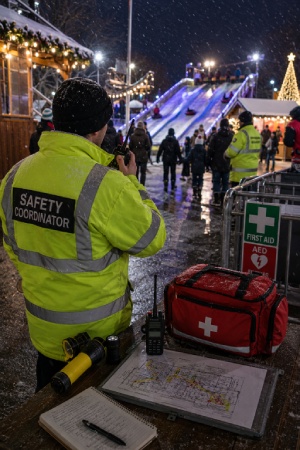
Public confidence in a large seasonal attraction lives or dies on the strength of its safety framework. Visitors rarely think about what sits behind the experience – the inspections, the permits, the emergency protocols – but operators think about almost nothing else.
Building the Risk Framework Before Opening Day
Regulatory compliance typically begins six to twelve months before an attraction opens. Temporary structure permits, fire safety sign-off, electrical certification, and public entertainment licences must all be secured before a single guest walks through the gate. Local authority inspections often cover load-bearing capacity for temporary stages and viewing platforms, emergency egress routes, and lighting levels across pedestrian zones. A minimum of 50 lux at ground level is a common benchmark for outdoor pathways in public events, though cold-weather venues frequently aim higher to compensate for reduced visibility caused by frost, steam, and low winter light.
Medical provision is non-negotiable. Most operators at scale – sites drawing 50,000 or more visitors across a season – contract dedicated first aid teams with at least one paramedic on site during peak hours. Defibrillators positioned within three-minute walking distance of all public zones, clear radio communication protocols, and designated emergency vehicle access routes are standard expectations from both insurers and licensing authorities.
Cold-Weather Hazards and Dynamic Decision Making
Winter introduces hazards that simply don't appear in summer event planning. Ice formation on walkways, steps, and ride infrastructure can develop within minutes when temperatures drop overnight. Structural stress on tensile canopies and temporary frames increases under snow load, and equipment – from ticket scanners to ride motors – performs differently at minus five than it does at ten degrees.
Operators manage this through dynamic risk assessments updated daily, sometimes hourly. Weather monitoring contracts with specialist meteorological services give site managers real-time wind speed, temperature, and precipitation data. Most venues operate closure thresholds – for example, suspending tubing hill operations when wind gusts exceed 35 mph – and staff are trained to implement these decisions without waiting for senior sign-off. Speed matters. A defensible decision made at 7am protects both guests and the organisation's liability position.
Why Staff Training and Communication Systems Matter During Winter Operations
Even the best-designed seasonal attraction can struggle if the people operating it are not prepared for changing winter conditions. Large public venues rely heavily on communication, coordination, and consistent staff training to keep operations moving safely once visitor numbers increase. During peak weekends, teams often handle thousands of guests across multiple zones at the same time, which means even minor communication delays can quickly create congestion, confusion, or safety concerns.
Pre-Season Staff Preparation
Most large attractions begin staff onboarding several weeks before the venue opens. Training sessions cover more than customer service basics. Staff learn evacuation routes, emergency procedures, crowd management techniques, and equipment operation relevant to their assigned zones. Operators running activities like tubing hills or skating rinks typically require practical assessments before employees are approved to work independently.
Real-Time Communication Across the Site
Large winter attractions operate through layered communication systems. Zone supervisors usually maintain direct radio contact with security teams, maintenance crews, medical staff, and central operations management throughout the day. This allows operators to react quickly when queues grow unexpectedly, weather conditions change, or equipment failures occur.
Digital monitoring has become increasingly common as venues scale up. Some operators now use live occupancy tracking, CCTV monitoring, and queue analytics to identify pressure points before they become visible to guests. If one attraction zone becomes overcrowded, staff can redirect visitors toward quieter areas using signage updates, app notifications, or roaming personnel. This type of responsive communication improves both safety and visitor satisfaction during high-capacity evenings.
Key operational communication priorities often include:
- Monitoring weather updates and surface conditions in real time
- Reporting maintenance issues before they become hazards
- Coordinating medical response teams during incidents
- Managing queue capacity at rides and activity zones
- Updating guests about delays, closures, or schedule changes
- Maintaining clear evacuation and emergency access routes
Successful Winter Attractions Are Engineered, Not Improvised
Every winter event that feels effortless to guests represents months of deliberate, often unglamorous groundwork that most visitors never see. The magic of a tubing hill lit at dusk, a pop-up ice village humming with activity, or a light installation drawing thousands of people through a park on a frozen Saturday night – none of it happens by accident. Operators who treat seasonal infrastructure as a secondary concern, something to figure out closer to opening day, tend to find out quickly how unforgiving cold-weather public environments can be. Permitting delays, ground conditions that prevent proper anchoring, heating systems that underperform at minus fifteen, crowd flow that no one modelled – these are the failure points that close events early or damage reputations permanently. Getting it right means treating a temporary winter attraction with the same operational seriousness you would apply to a permanent public venue. Rigorous safety planning, load-tested structures, qualified staff, and a clear incident response plan are not optional refinements – they are the foundation. Creative ambition is what draws the crowd; disciplined infrastructure and proactive operations are what keeps them safe and coming back. Design the experience as a fully functioning public environment from day one, and the seasonal magic tends to take care of itself.