Why Food Infrastructure Is Central to the Winter Festival Atmosphere
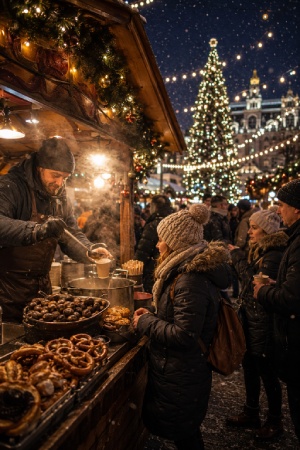
Thermal comfort functions as a precondition for enjoyment at outdoor winter events. When ambient temperatures drop below 5°C, visitor dwell time contracts sharply unless the environment actively counteracts physical discomfort. Food stalls and hot beverage stations are among the most reliable mechanisms for achieving this, not simply because they provide warmth, but because they create behavioral anchors that slow foot traffic, encourage lingering, and extend the overall visit duration.
Experiential design theory distinguishes between functional provision and atmospheric contribution, and food infrastructure operates on both registers simultaneously. A mulled wine station at a German-style Christmas market, for instance, delivers thermal relief as a functional outcome while generating aromatic cues, visible steam, and ambient queue activity that collectively signal festivity. The sensory layering produced by visible food preparation, whether a vendor turning roasted chestnuts or a baker pulling trays from a portable oven, reinforces the psychological framing of the event as special and seasonal. These cues are not incidental; they are, in event-management terms, deliberate place-making devices that anchor a visitor's sense of occasion.
Circulation patterns within festival sites are also shaped by food stall placement in ways that directly affect satisfaction outcomes. Research on spatial behavior at outdoor markets consistently finds that strategically positioned hot food vendors draw visitors deeper into festival grounds, reducing congestion at entry points and encouraging exploration of peripheral vendor areas. A 2019 study examining visitor flow at five European winter markets found that sites with distributed food provision across multiple zones recorded 23% longer average dwell times than those with centralized catering arrangements.
Behavioral reinforcement operates at a subtler level as well. The act of holding a warm drink or eating while standing outdoors creates a sensory contrast that many visitors report as intrinsically pleasurable, a finding consistent with embodied cognition research suggesting that physical warmth elevates perceived social warmth and affective engagement with the surrounding environment. There's no denying that a hot chocolate, consumed in cold air, does more atmospheric work than its caloric value suggests.
How Hot Beverages and Seasonal Merchandise Extend Engagement
Among the most consistent behavioral patterns observed at winter festivals is the tendency for visitors to linger longer when low-cost, warmth-providing consumables are readily available. A cup of mulled wine or hot chocolate functions as more than a purchase; it gives visitors a reason to pause, occupy a space, and extend their physical presence at the event. Research into dwell time at outdoor markets suggests that visitors who make an early consumable purchase spend, on average, 20–35% longer on-site than those who do not. The act of holding something warm is both physically comforting and socially orienting – it anchors people to a spot, encourages conversation, and slows the pace of movement through the venue.
Hot beverages also carry strong ritual associations that align naturally with winter festival identity. Mulled wine at German-style Christmas markets, spiced cider at rural harvest-adjacent events, or a regional specialty like glögg at Scandinavian-themed celebrations all signal authenticity and seasonal specificity. These signals matter to visitors constructing a coherent experience. When the beverage offer matches the broader aesthetic of the event, it reinforces what researchers sometimes call "place identity congruence," the sense that every element of the environment belongs together.
Seasonal merchandise operates through a related but distinct mechanism. Ornaments, hand-knitted goods, scented candles, and locally made crafts are rarely planned purchases; they are almost entirely impulse-driven, triggered by proximity, ambient warmth, and the psychological state visitors enter when they feel festively engaged. A 2019 consumer behavior study examining holiday market spending in the UK found that 62% of merchandise buyers reported making the decision to purchase within two minutes of encountering the product. The object then becomes a souvenir in the fuller sense – a material anchor for memory.
There's no denying that merchandise and beverages together form a feedback loop. Comfort encourages browsing; browsing increases exposure to goods; goods purchased deepen emotional investment in the event as a whole.
Local Vendors as Economic Stakeholders and Authenticity Producers
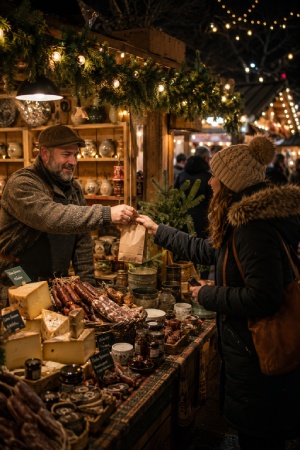
Independent traders and regional producers occupy a position at winter festivals that extends well beyond simple commercial participation. When a market stall sells locally smoked meats, handmade ceramics, or regionally sourced mulled wine, it functions as a credibility signal for the event itself. Visitors increasingly read vendor composition as an indicator of authenticity, and festivals that rely heavily on national franchise operators or generic merchandise risk being perceived as interchangeable with any other seasonal event.
The economic case for prioritizing local vendors is well-supported by research on tourism spending circulation. Studies examining Christmas markets in mid-sized European cities have found that when independent local traders hold the majority of stalls, a significantly higher proportion of visitor spending remains within the regional economy. A 2019 analysis of German Weihnachtsmarkt vendor structures estimated that locally owned stalls retained roughly 68% of revenue within the host municipality, compared to approximately 34% for externally operated concessions. That gap matters considerably for destination economies dependent on seasonal tourism.
Community identity is another dimension that tends to get underweighted in festival planning. Local artisans and food producers carry biographical and geographic ties to the place that chain operators simply cannot replicate. A cheesemaker from a nearby farm or a baker using a generations-old recipe does something for a festival's sense of place that no corporate catering contract can substitute.
Tensions emerge, though, and they are not trivial. Smaller vendors frequently struggle with the pricing pressures imposed by high stall fees, which can favor established traders over genuinely local producers entering the market for the first time. Quality control presents a parallel challenge. Festival organizers must balance the desire for local representation against the operational reality that not every independent vendor has the capacity, food safety certification, or production volume to meet peak demand reliably. Some festivals have addressed this through tiered vendor support programs, offering reduced fees or shared infrastructure to qualifying local participants, though implementation remains inconsistent across the sector.
Designing a Vendor Mix That Matches Visitor Expectations
Curation decisions made before a single stall opens have an outsized effect on whether a winter festival feels authentic or assembled. Organizers at established events like Cologne's Weihnachtsmarkt and Edinburgh's Christmas market have long understood that product diversity is not simply about consumer choice – it directly shapes the sensory atmosphere visitors arrive expecting. Mulled wine, roasted chestnuts, and spiced baked goods are not optional extras; they function as environmental anchors that signal seasonal occasion. Removing or underrepresenting them risks the event reading as a generic outdoor market rather than a winter celebration.
Spatial layout compounds this effect considerably. Zoning vendors by category – hot food and beverages near entrance points, artisan goods and merchandise toward the interior – serves two practical purposes: it disperses queues across the site and draws visitors deeper into the event, increasing dwell time and secondary spend. Observed patterns from high-footfall winter markets suggest that clustering all hot beverage stalls in a single area reliably creates bottlenecks, particularly during peak evening hours when temperature drops accelerate demand. Distributing mulled wine or hot cider vendors across two or three zones reduces that friction without diluting the product's atmospheric contribution.
Shelter and seating infrastructure are frequently underestimated in planning documents but consistently cited in visitor satisfaction studies as primary comfort factors. Covered seating adjacent to food stalls – not isolated in a separate pavilion – allows visitors to eat, rest, and remain engaged with the vendor environment simultaneously. This proximity sustains spend rather than encouraging early departure.
Licensing and hygiene compliance cannot be treated as administrative afterthoughts. Visible hygiene ratings, consistent branded signage, and coherent stall aesthetics contribute to perceived quality across the vendor mix as a whole. A single poorly maintained stall in a high-traffic zone can affect perceptions of the surrounding vendors. Organizers at events exceeding 50,000 annual visitors increasingly apply tiered vendor audits at mid-season to maintain standards throughout the run, not only at opening.
The Influence of Food Variety on Different Visitor Demographics
Winter festivals rarely attract a single type of visitor. Families with children, younger adults seeking nightlife-oriented experiences, older tourists interested in cultural traditions, and international travelers all move through the same environment with different expectations. Food variety becomes one of the few universal tools capable of satisfying these overlapping audiences simultaneously. A festival offering only basic fast food options may satisfy convenience needs, but it often fails to create the emotional or cultural engagement visitors associate with memorable seasonal events.
Research into visitor segmentation at outdoor festivals consistently shows that food diversity affects satisfaction differently across age groups and travel motivations. Families tend to prioritize convenience, seating access, and child-friendly menu options, while younger visitors are more responsive to novelty, presentation, and social-media-friendly products. International visitors often seek regional specialties that help distinguish one destination from another. This is why successful winter festivals increasingly combine traditional staples with newer culinary trends rather than relying entirely on nostalgic offerings.
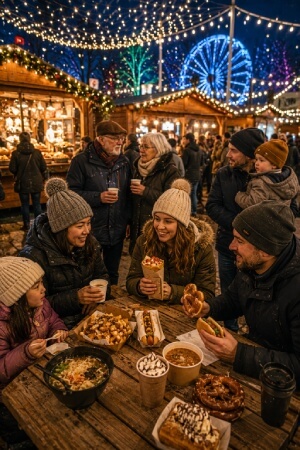
Several factors tend to shape how visitors evaluate the food experience at winter festivals:
- Availability of regional or locally inspired dishes
- Clear pricing and visible menus during peak periods
- Vegetarian, vegan, and allergy-aware food options
- Seating and heated rest areas near food zones
- Short queue times during high-traffic evening hours
- Beverage variety beyond standard hot chocolate or mulled wine
Food diversity also affects repeat visitation patterns more than many organizers initially expect. Visitors who associate a festival with a distinctive culinary identity are more likely to return annually because the experience feels tied to a specific place rather than interchangeable with competing events. A winter market known for regional pastries, locally brewed seasonal drinks, or specialty comfort foods develops stronger destination memory than one relying heavily on generic concession stands.
There's also a broader social dimension at work. Food stalls often become informal gathering points where groups pause, regroup, and spend extended periods talking rather than moving quickly through attractions. In practical terms, this slows visitor circulation in a beneficial way, increasing engagement with surrounding vendors and entertainment areas. The result is an event atmosphere that feels active without becoming rushed, which is one of the defining qualities visitors consistently associate with successful winter festivals.
Atmosphere Depends on More Than Entertainment Alone
Evidence drawn across visitor satisfaction studies, local economic analyses, and festival operator accounts consistently points to the same conclusion: winter festivals perform best commercially, socially, and experientially – when food, beverages, merchandise, and vendor participation are treated as deliberate components of event design rather than peripheral revenue opportunities. The sensory environment that hot food and seasonal drinks produce, the authenticity that locally sourced vendors signal, and the economic circulation that community-based traders generate are not separate outcomes to be managed independently. They operate together, shaping how visitors perceive the event, how long they stay, how much they spend, and whether they return. Organizers who plan vendor strategy late in the production cycle, or who prioritize commercial yield over curatorial coherence, tend to produce festivals that feel transactional rather than immersive. For policymakers supporting winter tourism, the implication is equally direct: funding frameworks and event licensing conditions should reflect the understanding that vendor ecosystems are experience infrastructure, not supplementary income streams, and that their quality, diversity, and community embeddedness are measurable determinants of the visitor outcomes that public investment is intended to support.